
A chef’s table wins when you want intimate, theatrical interaction with the person cooking your food. An open kitchen wins when you want atmosphere, transparency and no formal commitment. The trade-off is simple: proximity and story versus noise, aroma and a bit less privacy. Pick based on the occasion, not the trend.
TL;DR:
Open kitchens typically require higher costs for ventilation, acoustics, and staff standards, leading to higher menu prices and slower table turnovers.
A chef’s table offers an intimate, curated experience with longer, unhurried service, ideal for special occasions but limited in group size and accessibility.
Visibility into the kitchen enhances perceived food quality and trust through transparency, but can amplify noise and aromas, reducing privacy and comfort for some diners.
Cuisines built around visual techniques and fast service, like sushi or raw bars, align naturally with open kitchens, while tasting menus suit the slower, storytelling style of chef’s tables.
Complementary use of both formats is common, with striking “star stations” for spectacle and closed kitchens for practicality, creating a balance of trust and efficiency.
Table of Contents
What is a chef’s table vs an open kitchen?
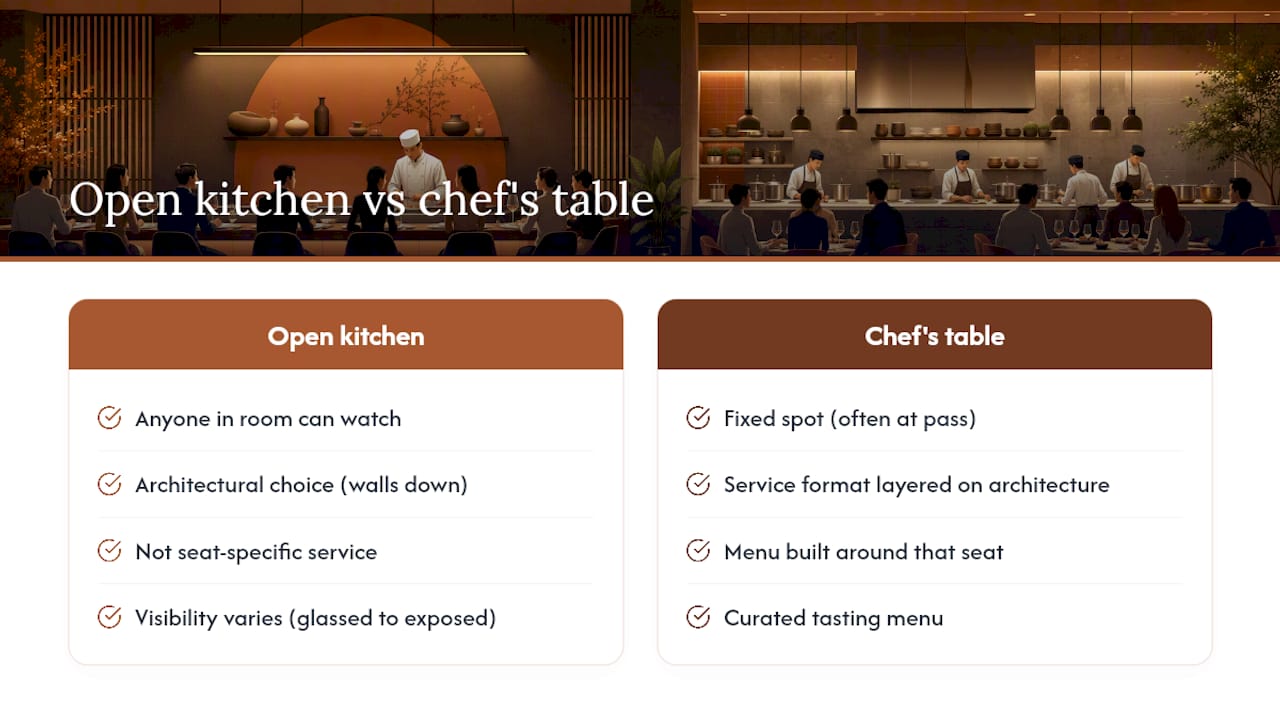
An open kitchen is an architectural choice. Walls come down, sightlines open up, and diners anywhere in the room can watch the cooking happen, whether they booked a specific seat or not. It ranges from a glassed-in exhibition station in a fine-dining room to a fully exposed line in a fast-casual spot.
A chef’s table is a service format layered on top of that architecture. It usually means a fixed spot, often right at the pass or counter, with a curated tasting menu and direct conversation with the chef running the line. The two overlap constantly, but they answer different questions: open kitchen asks “can you see the kitchen?” A chef’s table asks “are you seated at it, with a menu built around that seat?” A restaurant can have an open kitchen with no chef’s table at all, and in rare cases a chef’s table exists just outside a mostly closed kitchen.
How does the dining experience actually differ?
Distance changes everything. A standard table gives you ambient noise and maybe a glimpse of flames through a pass. Counter seating at an open kitchen puts you close enough to smell the char on a steak. A chef’s table usually closes that gap entirely, sometimes to arm’s length from the cutting board.
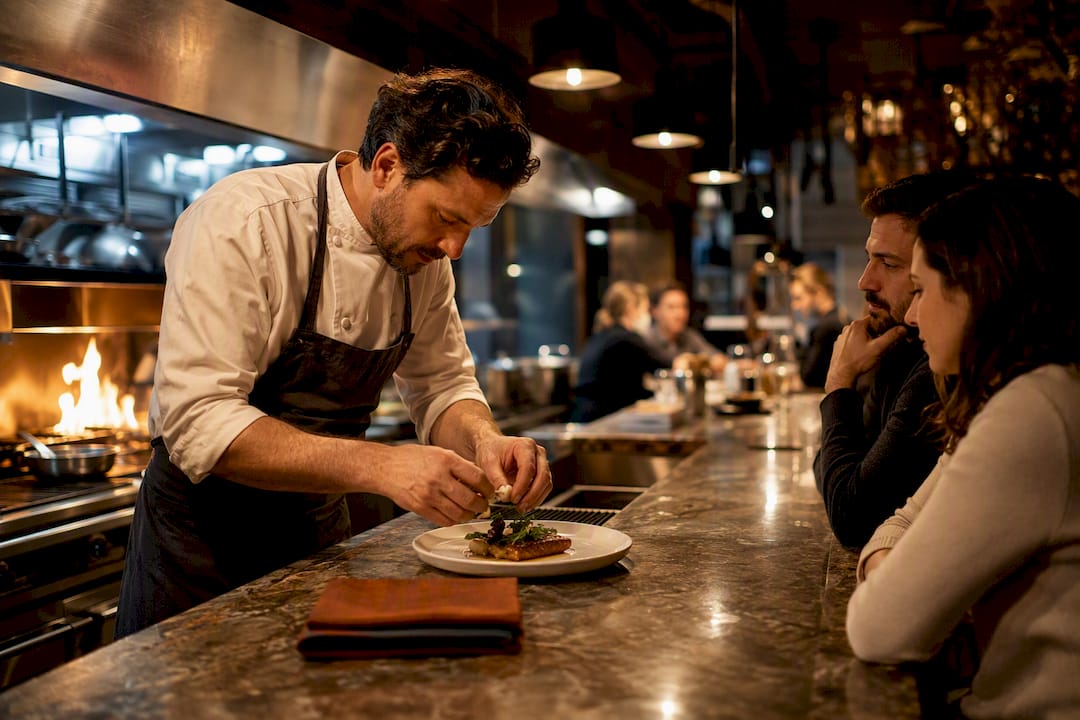
That closeness changes the conversation, too. At a chef’s table, you are not just watching, you are often being talked to: why this fish, why that reduction, why the plate is fired now and not two minutes ago. Open-kitchen seating without a formal chef’s table gives you the show without the script.
What changes for a diner moving from a regular table to either format:
-
Proximity: standard table (10 to 20 feet from any cooking) versus counter seat (arm’s length to a few feet) versus chef’s table (often shoulder to shoulder with the chef)
-
Interaction: passive observation versus occasional banter versus structured, ongoing dialogue about technique and sourcing
-
Sensory load: clatter, ticket calls and open flame noise are louder and more constant the closer you sit
-
Pacing: chef’s tables tend to run long and unhurried, open-kitchen seating moves at the room’s normal pace
The real pros and cons of each format
Visibility works in a restaurant’s favour more often than people expect. Watching food get made can raise perceived meal quality because transparency builds a kind of accountability. If nothing is hidden, diners tend to trust the outcome more, whether the technique is a slow braise or a thirty-second sear.
Here’s the honest trade-off list, gains and losses together:
-
Transparency builds trust. Seeing the process, not just the plate, changes how diners judge quality before the first bite.
-
Theatre adds value diners can’t get elsewhere. A chef narrating a dish is a different product than a server reciting a description.
-
Noise and smell come with the view. Diners consistently report louder rooms and stronger aromas as the main downside of open kitchens.
-
Privacy shrinks. A first date or a quiet business dinner is a worse fit for a seat two feet from a hot line.
-
Staff carry emotional labour they didn’t sign up for in a closed kitchen. Once a kitchen is visible, the chef’s role shifts toward public performance, managing composure and presentation on top of the cooking itself.
Why open kitchens cost more to build and run
Ripping out a wall between kitchen and dining room sounds simple. It isn’t. Open layouts demand serious investment in ventilation and acoustic control, because heat, smoke and noise that used to stay behind a door now spill straight into the dining room. Industry analysis on kitchen design consistently flags HVAC and acoustic upgrades as the biggest added cost of going open.
Presentation standards go up, too. A line cook who used to work in a back room now has a dining room watching every motion, which means uniforms, station cleanliness and even knife technique become part of the guest experience, not just the food. Restaurants often solve this with a hybrid: expose the “star stations”, like a wood-fired grill or a pasta bar, while keeping messy prep and dishwashing out of sight.
All of that flows into the menu and the bill. Higher build costs and stricter staffing standards tend to push open-kitchen and chef’s table restaurants toward higher price points, tighter reservation windows and slower table turns, since a chef’s table seating in particular is built around a longer, unhurried service.
Which format actually fits your evening?
Match the format to the occasion, not the hype. A chef’s table works best when the meal itself is the event: an anniversary, a milestone birthday, a food-obsessed friend’s visit. Open-kitchen seating fits looser plans, a casual dinner with atmosphere but no script to follow.
A few practical filters before you book:
-
Group size: chef’s tables usually cap out around 6 to 10 guests; larger groups fit open-kitchen dining rooms far more easily
-
Sensory sensitivity: noise-averse diners or anyone bringing young kids should lean toward a standard table, even in an open-kitchen restaurant
-
Budget and time: chef’s tables run longer and cost more per seat; open-kitchen counter seats give you the view without the commitment
-
Accessibility: ask specifically about seat height, aisle width near the pass, and whether the chef’s table area is step-free
How to book and enjoy either experience
Booking a chef’s table means asking direct questions upfront: how many courses, how long does service run, and how well can the kitchen handle allergies or dietary restrictions within a fixed tasting menu. Some kitchens can flex a dish on the fly; others built the whole menu around a single narrative and can’t easily swap pieces out.
Etiquette matters more here than at a normal table. Keep conversation at a reasonable volume, don’t crowd the pass with your phone for every shot, and let the chef lead the pacing rather than requesting rush service.
For open-kitchen seating without a formal table booking, arrive slightly early and ask the host for a counter seat directly. Early dinner service tends to have calmer energy than a packed 8 p.m. rush.
Pro Tip: Call ahead and ask which station is visible from your seat. A raw bar or grill station makes for a very different night than a view of the dish pit.
How Brévant chooses which experiences to feature
Brévant looks past the gimmick. A restaurant earns a spot in the guide for technique, service consistency and purposeful design, not simply because the kitchen has glass walls. A chef’s table gets highlighted when the format adds something real: direct storytelling, a genuinely different menu, service that justifies the extra time and cost. An open-kitchen restaurant earns a mention when the layout enhances the room rather than just exposing noise and clutter. Explore curated picks in cities like Charlottetown and Ottawa to see both formats done well.
Where open kitchens and chef’s tables actually came from
Exhibition cooking is centuries old, but the modern American open kitchen traces largely to Wolfgang Puck’s Spago in the 1980s, a restaurant that put the cooking line in full view of the dining room as a deliberate design statement rather than an accident of space. That single choice reshaped how chefs work, turning the kitchen into part of the show rather than a hidden backstage.
The chef’s table has separate, older roots. It grew out of the European tradition of chefs inviting favoured guests, regulars, food writers, other chefs, to sit near the kitchen and eat whatever came off the line that night, often unplanned and off-menu. That informal gesture eventually became a structured product: a fixed seat, a set price and a curated tasting menu built specifically for that spot.
The two traditions merged as open-plan dining rooms spread. What started as a hospitality gesture, a good seat for a friend of the house, became a bookable, revenue-generating format once restaurants realized diners would pay a premium for it. Fast-casual chains borrowed the transparency piece without the personal service, exposing tortilla presses and grill lines to build trust on speed and freshness rather than intimacy. Fine dining kept the personal element and pushed the price and pacing further, turning a favour into an experience with its own reservation category.
Does watching the kitchen actually change how a meal feels?
Yes, and the effect is measurable in how diners rate the exact same food. Visibility into the cooking process creates a kind of built-in credibility: if you watch a scallop go from raw to seared in ninety seconds two feet away, you trust that sear in a way a plated description never earns. That’s the mechanism behind higher perceived meal quality in kitchens diners can actually see.
Engagement compounds the effect. A diner who asks a chef why a sauce gets finished with brown butter instead of cream walks away remembering that detail, and remembering the restaurant because of it. That’s the core difference between watching a kitchen and sitting at a chef’s table: one is ambient theatre, the other is a guided conversation that turns a meal into a specific memory rather than a general good time.
The flip side is real, too. Not every diner wants a running commentary on their dinner, and a couple trying to have a quiet, focused conversation can find the performative energy of a chef’s table exhausting rather than delightful. Engagement cuts both ways depending on what the diner actually came for that night.
Which cuisines and restaurant types lean into each format
Open kitchens show up most naturally in cuisines built around visible technique and speed: wood-fired pizza, robata grills, ramen counters, dim sum stations, ceviche and raw bars. The cooking itself is fast, visual and doesn’t require hiding messy multi-step prep, which makes the exposure a marketing asset rather than a liability.
Chef’s tables cluster in tasting-menu fine dining, where the format’s slower pacing matches the format’s storytelling ambitions. Sushi counters are the clearest hybrid: an omakase bar is functionally both an open kitchen and a chef’s table at once, since the seating, the menu and the chef interaction are all built around that single counter.
Casual and fast-casual concepts tend to use open kitchens without any chef’s table at all. A build-your-own bowl chain or a neighbourhood taqueria benefits from the transparency, freshness and speed cues, without the labour cost of running a dedicated tasting-menu seat. That’s a deliberate operational choice: exposure without the staffing and pricing commitment a chef’s table demands.
Famous restaurants that built their identity on each concept
Spago remains the reference point for the open-kitchen movement in North American fine dining, the restaurant most credited with normalizing an exposed line as a design centrepiece rather than a back-of-house afterthought. Its influence rippled outward into both upscale dining rooms and, eventually, fast-casual chains that adopted visible prep stations as a trust signal rather than a luxury feature.
Chef’s tables took a different path to fame, built restaurant by restaurant around specific chefs whose personalities became part of the product. High-profile tasting counters, sushi omakase bars, and pass-side seats at destination tasting-menu restaurants turned the format into a bookable experience in its own right, one diner specifically travel for rather than stumble into.
Both traditions now show up side by side in the same cities, sometimes in the same room, as restaurants increasingly build one exposed “star station” for spectacle while keeping the rest of the kitchen closed for practicality.
Why the spectacle only works with real substance behind it
Watching a kitchen work is genuinely great theatre, and that’s exactly why so many restaurants lean on it. But a glass wall or a counter seat doesn’t fix mediocre food. Curated recommendations matter because travellers and food lovers deserve exposure without the guesswork of stumbling into a kitchen that’s all show. The best chef’s tables and open kitchens earn the spectacle by backing it with real service and real technique.
— Brévant
Find curated chef’s-table and open-kitchen picks near you
Hunting down a genuinely great chef’s table or open-kitchen seat, instead of a restaurant that just installed a glass wall, is exactly the guesswork Brévant Guide exists to remove. Rather than scrolling endless review sites, you get a short, vetted list of restaurants across major Canadian cities where the format actually earns its price tag.

Planning a trip or a special night out? Check curated picks in Moncton, Montréal or Calgary and book the seat that actually matches what you’re after, whether that’s a quiet counter view or a full chef’s table conversation.